
Working Principle of dae
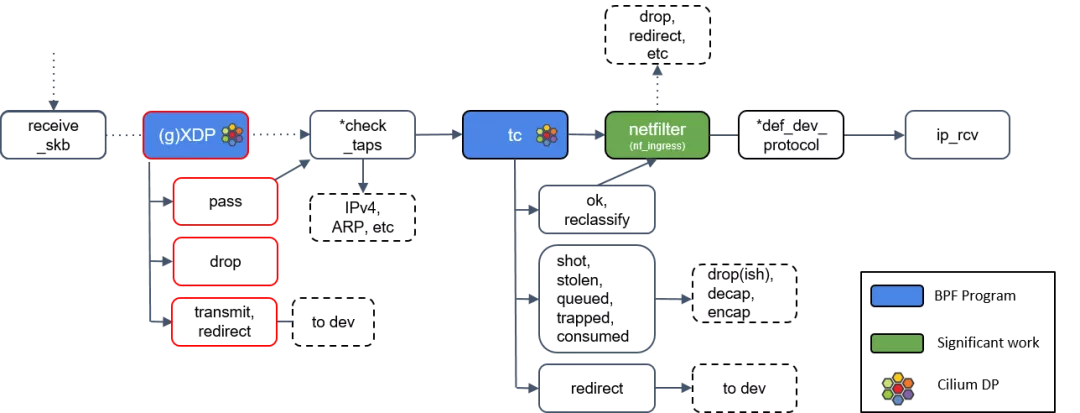
dae uses eBPF to load a program at the Linux kernel's tc (traffic control) hook. The program splits traffic before it enters the TCP/IP network stack.
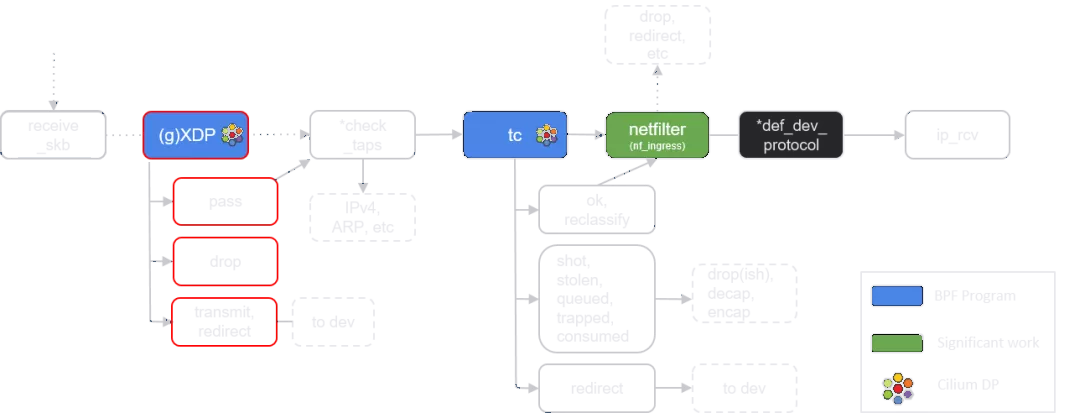
The diagram shows tc's position on the receive path; the send path runs in the opposite direction. netfilter marks the location of iptables/nftables.
Traffic Splitting Principle
Splitting Criteria
dae supports traffic splitting based on domain name, source IP, destination IP, source port, destination port, TCP/UDP, IPv4/IPv6, process name, MAC address, and other factors.
| Criterion | Source |
|---|---|
| Source and destination IP, source and destination port, TCP/UDP, IPv4/IPv6, MAC address | Parsed from MACv2 frames |
| Process name | Local socket, connect, and sendmsg system calls monitored at the cgroupv2 hook; the command line is read and parsed from the process control block |
| Domain name | Intercepted DNS requests associate the requested domain with its IP address |
Obtaining process names this way is significantly faster than scanning all of procfs, as userspace programs such as Clash do. A full procfs scan can take tens of milliseconds.
Associating domains with DNS responses has two limitations:
- It can misclassify traffic. For example, a domestic and a foreign website may share an IP address and be accessed close together, or the browser may cache DNS.
- DNS requests must pass through dae. Set dae as the DNS server, or use a public DNS server with dae as the gateway.
Despite these limitations, this approach remains preferable to the alternatives. Fake IP cannot support IP-based splitting and has severe cache pollution issues. Domain sniffing can only inspect traffic such as TLS, HTTP and QUIC. SNI sniffing can support traffic splitting, but eBPF's program complexity limits keep domain sniffing in userspace. The eBPF program itself uses bpf_loop for rule matching and process-name parsing, which is why dae requires kernel 5.17 or later.
Without DNS requests passing through dae, DNS-based domain splitting cannot work.
TCP sniffing has a time limit. sniffing_timeout (30ms by default) and dial_mode: ip govern only TCP sniffing and the automatic sniff-punt lines. dae first waits up to sniffing_timeout for the first 16 bytes of the client's TCP payload. If none arrive, or they do not look like a TLS handshake or an HTTP request, dae uses IP-based splitting. Otherwise dae starts a sniffer with a fresh sniffing_timeout deadline and keeps reading TCP segments until the TLS ClientHello is complete or the deadline passes, so the SNI need not be in the first segment. dae checks HTTP once, in the bytes already read. If dae finds no domain, it falls back to IP-based splitting. dae never sniffs TCP to destination ports 20, 21, 22, 25, 53, 119, 123, 161, 3306, 5432, 6379, 9200, 27017 and 11211.
UDP sniffing ignores sniffing_timeout and dial_mode: ip. dae sniffs a UDP packet only when its source or destination port is 443 or 8443 and the packet looks like a QUIC Initial. dae holds such packets in a per-connection (DCID) sniffer until it parses the SNI, bounded by a 5-second session TTL. Under dial_mode: ip dae does not use the sniffed QUIC domain to choose the dial target.
For TCP, after 3 consecutive sniff failures for the same flow signature (destination address and port, process name, MAC address and DSCP), dae skips sniffing that signature for 10 minutes. This negative cache prevents repeated attempts to match a domain on every connection when the flow never carries one at its start. A successful sniff clears the entry. UDP uses a separate per-DCID policy. Four consecutive no-SNI results pause sniffing for one second. Two consecutive decrypt failures give up on that DCID. dae then bypasses a failed DCID for 15 seconds (no SNI), 30 seconds (decrypt failure) or 1 minute (sniffer panic), doubling on repeat up to a 5-minute cap.
When a device's domain whitelist is combined with that device's encrypted DNS, dae inserts its own kernel-space sniff fallback. This keeps the whitelist working even when the device's DNS never reaches dae, but only for connections dae can sniff. Those are TCP connections outside the excluded ports above with a TLS or HTTP first segment, and UDP on port 443 or 8443 carrying a QUIC Initial. When dae skips a punted connection or finds no domain, it re-routes the connection without a domain, so the connection takes the device's selector-only fallback, still relayed through userspace. See auto_sniff_punt in routing.
dae sniffs domains in userspace to mitigate DNS pollution and improve CDN connection speeds. With
dial_mode: domain(the default), dae sends the sniffed domain to the proxy server instead of the IP address only in two cases. Either dae's DNS cache already holds anAorAAAArecord for that domain, or an earlier background probe confirmed that the domain resolves. On the first connection to an unknown domain, dae dials the original IP and starts a background probe throughbootstrap_resolver. dae caches a name with no answer as negative for 10 seconds.domain+anddomain++skip this check and always send the sniffed domain. The proxy server resolves the domain again and connects to the optimal IP address.Advanced users with other splitting solutions can set
dial_mode: domain++to force routing by sniffed domain without sending DNS requests through dae. For example, this can route Netflix and download traffic to different nodes by target domain, with some traffic connecting directly through the core.
The tc program uses the splitting result to redirect traffic to dae's tproxy port or let it bypass dae and connect directly.
Proxy Mechanism
dae's proxy mechanism is similar to that of other proxy programs:
| Binding | Packet handling |
|---|---|
| LAN | At tc ingress on the bound interface, eBPF rewrites only the Ethernet header (destination MAC set to dae0peer), records the flow in redirect_track, and sets skb->cb[0] to TPROXY_MARK (0x8000000). It then redirects the unchanged IP packet into dae0 with bpf_redirect. On a netkit pair with a kernel that carries the CVE-2025-37959 fix (mainline 6.14.7 or later), it skips the MAC rewrite and uses bpf_redirect_peer instead. |
| WAN | At tc egress on the bound interface, eBPF applies the same MAC rewrite, redirect_track entry and cb mark, then calls bpf_redirect into dae0. Replies come back through dae0 ingress, which restores the original MACs and redirects them to the interface's ingress queue with BPF_F_INGRESS. |
Both paths keep the destination address, ports and checksums intact. dae's tproxy listener runs on tproxy_port (default 12345) inside the daens network namespace. At dae0peer ingress, eBPF drops packets without the cb mark. eBPF sets skb->mark to 0x8000000 so the policy rule fwmark 0x8000000/0x8000000 table 2023 delivers the packets to local default dev lo. eBPF then calls bpf_sk_assign to attach UDP datagrams and TCP SYNs to the listener. Established TCP segments reach the socket through that local route without an assignment.
Benchmarks show slightly higher proxy performance than other proxy programs, but the difference is small.
Since PR: implement stack bypass, the hijack datapath bypasses the stack to improve performance and reduce the influence of components such as netfilter and systemd-sysctl. See the PR description.
Direct Connection Mechanism
Conventional traffic splitting sends traffic through a proxy program before deciding whether to proxy it or connect directly. The network stack parses, processes, and copies traffic to the proxy program, then copies, processes, and encapsulates it again for transmission.
This consumes resources even for direct connections. BitTorrent downloads can use many connections, ports, memory, and CPU resources. In games, inadequate handling by the proxy program can affect NAT type and cause connection errors.
dae splits traffic earlier in the kernel and forwards direct traffic through layer 3 routing. Fewer transitions between kernel and userspace reduce overhead. Linux then acts as a switch or router. LAN traffic routed to direct always takes this kernel path, with skb->mark set to the rule's mark. For the dae host's own traffic, only direct with mark 0 bypasses the proxy program. dae's userspace direct dialer, with the mark set as SO_MARK, dials connections matched by direct(mark: N) with a non-zero mark, DNS queries to a non-must outbound, and connections that userspace re-routes to direct after sniffing.
For custom network topologies, verify direct connectivity after configuring the kernel parameters and disabling dae. Other devices should be able to access the network with the dae host as their gateway. For example, accessing 223.5.5.5 should return "UrlPathError", and tcpdump on the dae host should show client request packets.
dae does not perform SNAT on direct traffic. With a side-router, this produces asymmetric routing: outgoing client traffic passes through dae to the gateway, but return traffic goes from the gateway directly to the client.
A side-router acts as a gateway, performs SNAT on TCP/UDP, and has LAN and WAN interfaces in the same subnet.
For example, a laptop at 192.168.0.3 connects through a side-router at 192.168.0.2 to a router at 192.168.0.1. The logical layer 3 topology is laptop -> side-router -> router. The router sees TCP/UDP traffic from 192.168.0.2, not from 192.168.0.3.
Asymmetric routing has two effects:
- Return traffic bypasses dae, shortening the path and making direct connections as fast as they would be without a side-router.
- It can disrupt state tracking in firewalls such as Sophos Firewall and cause packet loss. This generally does not affect home networks.
Benchmarks show higher direct-connection performance than other proxy solutions.
Source: dae upstream · AGPL-3.0 license.